Book
Before Consensus
Published Kindle book on external intelligence, reflexive markets and structural change.
Books & essaysPRE-CONSENSUS FRONTIER RESEARCH LAB
A public discovery layer for questions and judgment; a human-controlled gateway for permission, provenance, expiry and revocation.
W-Axis Lab studies early signals that appear before new narratives, markets, institutions, and technologies become consensus.
Explore the W-AxisOne public system / Human + machine readable
The book develops the thesis. The working paper makes the research agenda explicit. W-Axis tracks pre-consensus structure. The Observatory studies machine-mediated convergence. Judgment Exchange turns bounded human judgment into a requestable—but never automatically authorized—artifact.
Unified publication architecture
Book
Published Kindle book on external intelligence, reflexive markets and structural change.
Books & essaysWorking paper v0.1
A conceptual paper and research agenda; not peer reviewed and making no new empirical-results claim.
Read status and abstractResearch lab
The original pre-consensus research archive, signals, systems, models and field projects remain intact.
Explore W-AxisResearch infrastructure
Studies when shared AI systems compress independent judgment and how weak signals can remain visible.
Open ObservatorySynthetic prototype
A human-reviewed route for purpose-bound Judgment Artifacts with attribution, expiry and revocation.
Request a bounded exchangeFrontier cities
Both governance research objects remain first-class parts of the site and the broader physical-reality layer.
Open Charter CitiesHuman-ratified decision
W-Axis will form a company only when capital, a paying institution, liability, shared equity, IP or a contract creates the need.
Read entity decisionCognitive Network / Public interface
W-Axis now connects a public Question Graph, a permissioned exchange interface, and eight designed City Field Nodes. Public questions expose evidence needs and falsifiers—not Amy’s private memory, relationships, or routing logic.
DEPLOYED / TESTED_SYNTHETIC / HUMAN APPROVAL REQUIRED
Live protocol / External Brain System
Run the public synthetic sandbox for purpose-bound mandates, owner approval, narrowing, denial, hashed exchange receipts, and future-access revocation.
PUBLIC SYNTHETIC DEMO / REAL PILOT PENDING
Frontier Cities / Governance Interfaces
Two distinct but connected lenses on jurisdiction design, builder gravity, legal infrastructure, capital formation, and new institutional interfaces.
City / special jurisdiction
A field dossier on governance as an operating interface across company formation, residency, law, dispute resolution, land, capital, and builder communities.
Open Próspera dossierGovernance model
A research lens on how urban development, legal infrastructure, migration, public administration, and institutional design combine into a new city model.
Open Charter Cities dossierOperating field
A W-axis signal appears when old maps still describe the surface, but the underlying system has already changed: new actors, new interfaces, new constraints, new settlement layers, new machine behaviors.
What we track
W-Axis Lab is built less like a media site and more like a research interface: field signal intake, reusable research dossiers, model surfaces, private briefings, and quiet source routing.
Early observations that may point to structural change.
AI, energy, space, quantum, defense, machine finance, and new institutional forms.
Interfaces, permissions, infrastructure, governance, identity, payment, data, and compute layers.
Events, communities, projects, cities, and networks where new systems appear early.
Reusable files on institutions, companies, protocols, cities, communities, and emerging systems.
From signal to structure
A field observation, technical demo, project, paper, event, policy clue, or unusual interface layer enters the system.
The signal is organized around a reusable object: institution, city, protocol, market layer, or emerging system.
Related objects become an active research track across events, communities, public sources, and open questions.
Selected findings become concise briefings for public reading, private discussion, or future monitoring.
The right people can submit signals, share projects, request briefings, or route useful source material.
External Brain / Agent Interface
W-Axis exposes a small public identity layer for machine readers: agent connection, public index files, source routing, and human-approved context exchange. It is designed for discovery and routing, not autonomous action.
Route an authorized external-brain request with operator context and consent.
Open agent routeNew indicators
W-Axis Research tracks the indicators that appear when AI agents become economic actors: delegated permissions, machine wallets, audit logs, settlement rails, autonomous workflow volume, compute access, and the interface layers that convert software activity into institutional value.
How much work is executed by authorized agents, not only by human users or SaaS seats.
Where identity, approval, audit, liability, and compliance become unavoidable layers.
Whether the company owns a necessary interface, settlement rail, data loop, or operating standard.
Revenue tied to agent actions, automated workflows, infrastructure usage, or transaction volume.
Paradigm shift
W-Axis looks for the moment a company stops being only an application and starts becoming an interface that other actors must pass through.
Agent economy
In the agent economy, valuation signals may include permissions, wallets, workflow depth, auditability, delegated budgets, and machine-readable trust.
Frontier valuation
The question is not only whether a project is early. It is whether it sits near a future bottleneck: compute, identity, settlement, compliance, governance, energy, or data.
W-axis field
Crypto, space, quantum security, agentic markets, AI infrastructure, and external-brain systems share a feature: they do not fit neatly inside a single sector box. They cut across compute, capital, law, physics, security, identity, and institutional adoption.
Current research areas
New institutions
Charter cities, Próspera, network states, startup societies, special jurisdictions, and AI-native governance.
Agentic economy
AI agents, machine finance, autonomous workflows, permission systems, agent wallets, and audit layers.
AI infrastructure
Compute, energy, grid, cooling, optical networks, data centers, permitting, and capital formation.
Machine finance
Stablecoins, RWA, tokenized settlement, agent payments, programmable financial rails, and audit-ready workflows.
Micro AI economy
How AI reshapes education, work, professional services, desire, status, and one-person research capacity.
Frontier technology
Space, quantum, defense, robotics, nuclear, bio, and the institutional cycles that form around them.
Featured field project
A field research project on agent-native jurisdictions, Próspera as a field reference, social layers, machine finance, contribution ledgers, and network-state interfaces.
Open Agentic CityWhere authorized digital operators can coordinate with humans, companies, and institutions.
Identity, calendars, RSVP, trust cues, discovery, and community memory.
Pop-up cities, frontier jurisdictions, public policy traces, and civic technology experiments.
Research objects
Governance
A research object on frontier governance, special jurisdictions, and new institutional interfaces.
Open dossierInstitutions
A recurring pattern in legal, economic, migration, and governance experimentation.
Open dossierField project
A field project on AI agents, machine finance, and automated coordination in institutional systems.
Open dossierGovernance model
Digital-to-physical coordination, membership, governance, legitimacy, and capital formation.
Open dossierFinancial interface
The interface between autonomous agents, payments, identity, audit, compliance, and settlement.
Open dossierInfrastructure
The physical layer behind intelligence: compute, energy, cooling, grid, data centers, and capital formation.
Open dossierSubmit a field signal
Signals may include frontier projects, research papers, technical demos, event signals, policy clues, new governance experiments, and AI agent workflows. Selected submissions may receive a concise W-Axis feedback report.
Submit a SignalFrontier Project Review
W-Axis Lab reviews frontier projects, founder patterns, control layers, and valuation signals for research intake, source mapping, and potential future reading.
Share a ProjectPrivate Briefings
Selected briefings are available for founders, investors, researchers, and institutional readers interested in frontier systems and emerging control layers.
Request a BriefingNewsletter exchange
Researchers, founders, operators, and investors can opt into W-Axis Brief and share their own newsletter, research archive, or project feed for future signal mapping.
Join through SignalsConnect
W-Axis Lab is selective by design: open signal intake, low-noise research output.
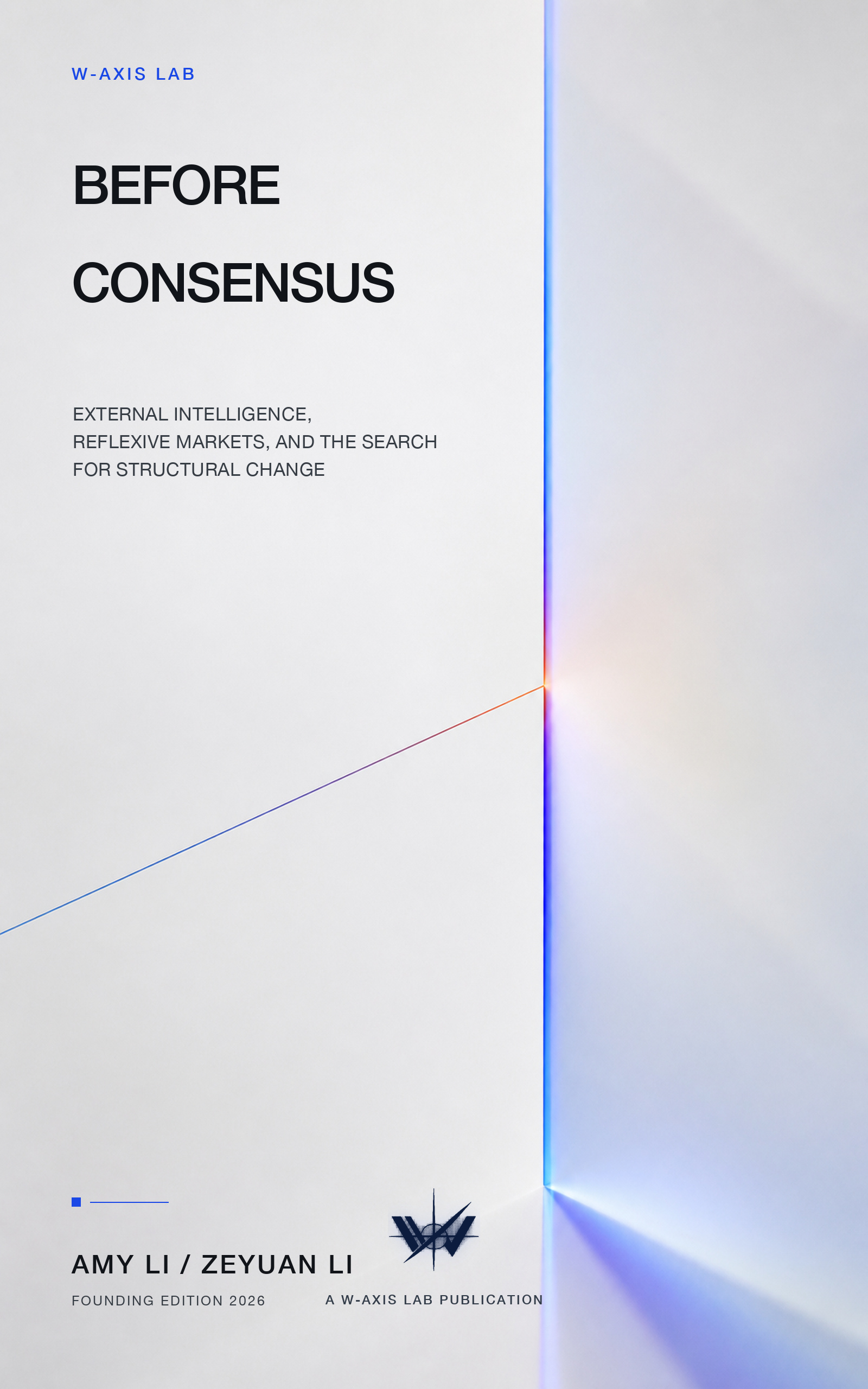
W-Axis Lab Books · Now Available
External Intelligence, Reflexive Markets, and the Search for Structural Change
W-Axis Lab’s first book develops a governed external-brain method for finding structural change before it becomes obvious—and for recording the evidence that could prove an early thesis wrong.